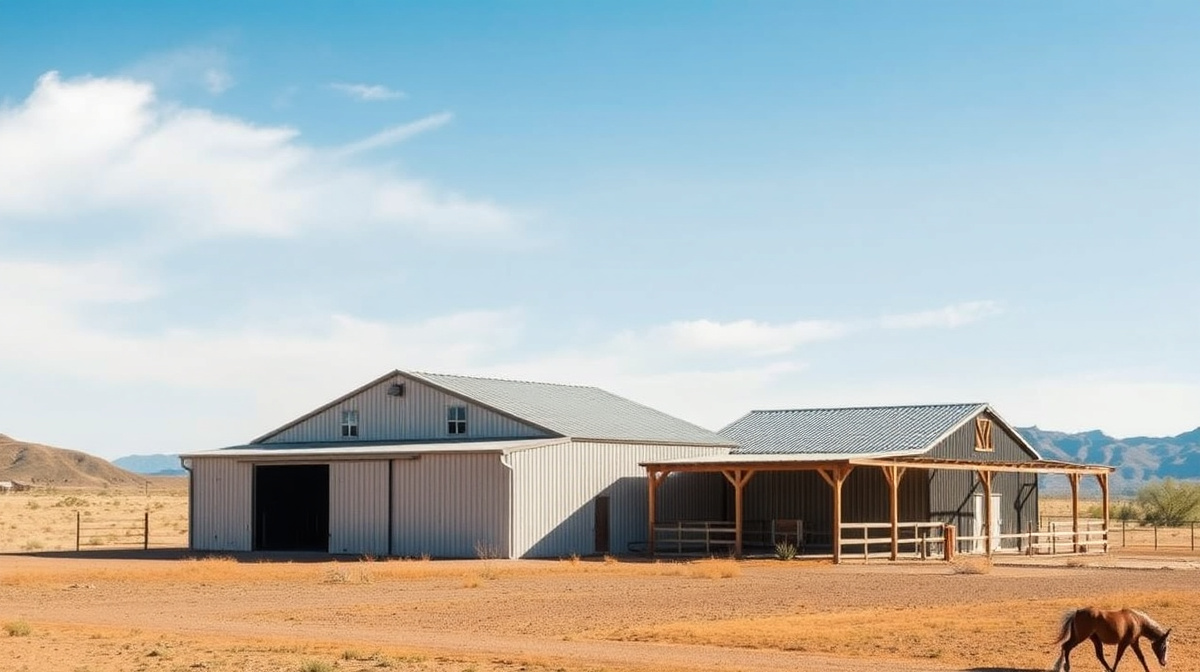
Short answer: yes, and often better than it works on a standard subdivision home, because ranch and rural buildings tend to have exactly the problems spray foam is best at solving — big uninsulated volumes, metal roofs and walls that swing to extreme temperatures, and gaps around doors, eaves, and utility penetrations that a stick-built house typically doesn't have. The harder question isn't whether spray foam works out here. It's figuring out what to insulate first, what a realistic budget looks like for a shop or barn instead of a house, and what to expect for scheduling when the property sits a genuine distance from Nogales proper.
That last part matters more in Santa Cruz County than it would almost anywhere else in the state. This is a county where a meaningful share of the housing stock isn't a house at all — it's a ranch, a small farm, an equestrian property, or a vineyard operation, spread across Patagonia, Sonoita, and the unincorporated rural county beyond either town. Those properties come with outbuildings that almost never got insulation attention when they were built, because the original construction budget went toward the barn walls standing up, not the barn holding a stable temperature.
What rural Santa Cruz County actually looks like
Patagonia sits around 4,200 feet with a small-town, rural character and noticeably cooler nights than Nogales proper — the kind of place where a working ranch shop or an outbuilding for equipment and feed storage is standard, not an exception. Sonoita, at roughly 4,885 feet, carries the coldest winter exposure anywhere in the service area, and it happens to also be Arizona's original American Viticultural Area (AVA) — a genuine cool-night wine region with vineyard operations, tasting rooms, and equestrian facilities that all come with their own outbuilding footprint. Beyond those two towns, greater Santa Cruz County spans a 3,200-to-5,000-plus-foot elevation range of agricultural land, off-grid parcels, and long, quiet stretches of ranch road where the nearest neighbor might be a mile off.
None of that is a marginal slice of the market here. It's a large, recurring part of what we get called out for — and it changes the conversation from “insulate the attic” to “which of these six structures do we tackle, and in what order.”
The structures that actually need it
A typical rural Santa Cruz County property isn't one building — it's a small cluster of them, and each has a different reason to get insulated:
- Metal shops and equipment barns. Bare metal roof and wall panels radiate summer heat straight into the interior and lose it just as fast on a freezing winter night. Anyone who has tried to work on equipment in an uninsulated shop at either extreme already knows this.
- Equestrian structures. Barns, tack rooms, and stalls around Patagonia and Sonoita benefit from a more stable interior temperature — for the animals, for feed and equipment storage, and for anyone spending working hours in them through a genuine winter.
- Wine-country outbuildings. Sonoita AVA properties often have storage buildings, small production spaces, and equipment sheds where temperature swings matter more than they would in a plain storage shed — cool-night viticulture is part of what makes this region's wine grapes work, and that same temperature sensitivity extends to how buildings on the property perform.
- Ranch homes and guest houses. Often older, often with minimal original insulation, and often paired with a detached garage or casita that never got the same attention as the main house.
Where to start: priority order on a ranch property
When a property has several structures and a single budget, we generally walk owners through the same priority order — spray foam on the roof deck and walls of whichever building sees the most daily use first, then work outward:
- ✓The main residence attic or roof deck — the single biggest source of both summer heat gain and winter heat loss in almost every rural home we inspect.
- ✓Any shop or barn where people work regularly — equipment repair bays, tack rooms, tasting or production spaces — where a stable interior temperature affects daily comfort and usability, not just energy cost.
- ✓Metal-roof and metal-wall structures specifically — these swing to more extreme surface temperatures than a shingled roof or a stucco wall, so closed-cell foam's rigidity and moisture resistance tend to earn their keep fastest here.
- ✓Equestrian or livestock structures where animal comfort and stored feed quality benefit from reduced temperature swings.
- ✓Detached garages, casitas, and guest structures — often the last building on a property to get attention, and often the easiest to seal in a single visit once the main structure is done.
- ✓Any building with known rodent or pest history — ranch outbuildings across this region see real rodent pressure, and old, compromised insulation is frequently part of that problem rather than part of the fix.
Off-grid and long-service-radius realities
A fair number of rural Santa Cruz County properties run partly or fully off-grid — generator or solar power, hauled or well water, sometimes a genuinely remote access road. None of that rules spray foam out. The application itself doesn't depend on grid power at the structure; our equipment is self-contained on the truck. What it does change is planning: we want to know about generator capacity if we're coordinating around it, road conditions if the site needs a specific vehicle or timing, and whether the structure has features — like an active livestock operation or a working production space — that affect when we can be on-site without disrupting the day.
None of that is a reason to skip the conversation. It's a reason to have it early, during the initial inspection, so the actual spray day goes smoothly instead of turning into a surprise.
Cost and scheduling, straight — not softened
We'd rather say this plainly than have a rural customer find out the hard way: a property well outside Nogales proper — deep in Sonoita, Patagonia, or unincorporated county land — may see a slightly longer dispatch window than a job inside town. That's simply a function of drive time and route planning across a genuinely spread-out service area, not a reflection of how seriously we take the job. We'd rather tell you that up front during scheduling than let you assume every property in the county gets the same same-week slot a Nogales-proper home does.
Cost works similarly to the rest of our pricing — driven by square footage, foam type, and access — but ranch and outbuilding jobs have their own shape worth calling out directly. A single-story metal shop with simple roof-deck access is often straightforward to spray; a barn with tight eave access, an active equestrian operation to work around, or multiple smaller structures spread across a property adds planning time even when the square footage is modest. The figures below are directional starting points for this region, not a quote — every property gets an on-site walkthrough before we put a number on it.
| Small shop or equipment barn (open-cell, roof deck only) | Typically in the low-to-mid four figures, depending on square footage and roof access. |
|---|---|
| Metal shop or barn (closed-cell, roof + walls) | Runs higher than open-cell per board foot given the added density and moisture resistance metal buildings benefit from. |
| Equestrian or multi-structure property | Scoped building by building — most owners start with the highest-use structure and phase the rest over time. |
| Rural dispatch window | Same general scheduling process as in-town jobs, with a modestly longer lead time acknowledged upfront for properties well outside Nogales proper. |
Directional ranges based on regional contractor pricing norms — every rural or ranch job gets a walkthrough and a written estimate before work is scheduled.
The season that actually tests a ranch building
It's tempting to think of insulation out here as a summer-only fix for a hot metal shop. That's only half the picture. Santa Cruz County sits in IECC Climate Zone 3B — a genuine dual-season climate with real summer highs in the 90s and, just as real, winter lows that regularly drop below freezing. Sonoita's roughly 4,885-foot elevation gives it the coldest winter exposure anywhere in the service area, and Patagonia isn't far behind at around 4,200 feet with noticeably cooler nights than Nogales proper.
An uninsulated metal barn doesn't just get brutally hot in July — it gets genuinely cold on a January night, which matters for stored feed, equipment that doesn't like hard freeze-thaw cycles, and anyone trying to work in that space before sunrise. Spray foam addresses both directions of that swing with the same sealed envelope, which is part of why it tends to make more sense for a ranch building in this region than a single-season fix aimed only at summer heat.
Open-cell or closed-cell for a shop, barn, or outbuilding?
For most ranch and rural structures, the choice comes down to the building envelope. Metal shops, barns, and other metal-panel structures generally do best with closed-cell foam — its rigidity adds real structural stiffness to a metal building and its moisture resistance matters when a building swings through freezing nights and monsoon humidity in the same season. Interior partitions, tack rooms, and simpler wood-framed outbuildings can often be handled well with open-cell foam at a lower cost per board foot when a full moisture barrier isn't the deciding factor. Our garage & shop insulation service covers this exact category of building in more depth, including detached shops and metal ranch buildings specifically.
If you're planning a new shop, barn, or ranch home rather than retrofitting an existing one, the cheapest time to spec spray foam is at the framing stage — our new-construction spray foam service walks through whole-envelope specs for rural Santa Cruz County builds, including how the spec reasonably shifts between a build near Nogales at roughly 3,865 feet and one near Sonoita at nearly 5,000 feet.
And if you're not sure which community your property falls under, or want to see how our service radius covers your part of the county, the service areas page breaks it down community by community — Nogales, Rio Rico, Tubac, Patagonia, Sonoita, and the greater rural county beyond them.
Ranch and rural properties are a real, recurring part of what we do in this county — not an inconvenient edge case we tolerate. Whether it's one shop that runs too hot in July and too cold in January, or a full cluster of buildings across an equestrian or vineyard property, the right starting point is the same: a straightforward, on-site look at what you actually have before anyone talks numbers.