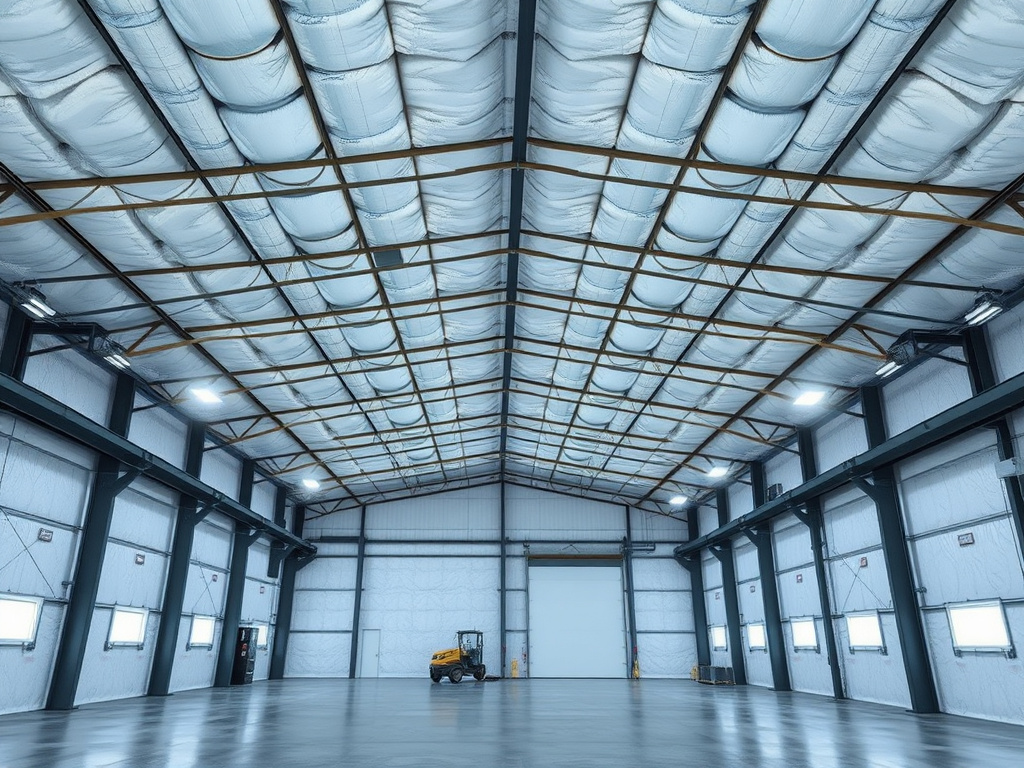
Cold storage, warehouses & metal buildings
Commercial Spray Foam Insulation — Cold Storage, Warehouses & Metal Buildings Near the Mariposa Port of Entry
Santa Cruz County's produce cold-chain economy runs on refrigerated buildings that ordinary metal-building insulation was never designed to handle. We spec closed-cell foam for the condensation and vapor-control problems that come with that territory — plus the metal buildings, ranch structures, and office/retail space that round out the region's commercial footprint.
Who we serve
Produce cold storage, dry-goods warehouses, ranch structures, and border-district office space
Commercial spray foam work in this region isn't one building type — it's a spread of property types that share a single border-economy driver. We regularly work on refrigerated and temperature-controlled produce distribution facilities, dry-goods and general distribution warehouses, customs-brokerage offices, metal-building ranch and agricultural structures, and office or retail buildout in and around the Nogales business district. Each of those needs a different foam spec, not a single one-size-fits-all commercial package.
What ties them together is the same regional reality: Santa Cruz County sits directly on the busiest commercial land port in Arizona, and the building stock here reflects that. A produce distributor's cold-storage bay, a customs broker's office suite, and a rancher's equipment shop all sit within a few miles of each other and all need an envelope specced for a genuine dual-season Zone 3B climate — not a copy-paste Phoenix metal-building template.
The Nogales commercial angle
Why cold-storage insulation is this region's defining commercial demand
Santa Cruz County hosts one of Arizona’s largest concentrations of cold-storage and warehouse real estate, and it exists here for a specific reason: the Mariposa Land Port of Entry in Nogales is Arizona’s busiest commercial port, processing an estimated $36 billion in annual trade. A large share of that volume is winter produce — more than 5 billion pounds of Mexican fruits and vegetables cross through Mariposa every year, most of it during the winter produce season when Mexican growing regions are in full harvest and U.S. domestic supply is thin.
That produce doesn’t move straight from the crossing to a retail shelf. It gets staged, sorted, and held at temperature in refrigerated and temperature-controlled warehouses across Rio Rico and greater Santa Cruz County before it continues north. U.S. Customs and Border Protection has expanded dedicated cold-storage inspection capacity at Mariposa in recent years, which is a direct signal of how much of the port’s traffic is now cold-chain freight rather than dry goods.
Refrigerated and temperature-controlled buildings have a building-science problem that a standard dry warehouse doesn’t: the temperature gap between a cooled interior and this region’s warm exterior air — plus a real monsoon humidity swing each July and August — drives condensation onto any interior surface that isn’t vapor-controlled. Metal roof decks and wall panels are especially vulnerable, because bare metal conducts temperature fast and condenses moisture readily wherever the assembly isn’t sealed.
Ordinary metal-building insulation — unfaced batts stapled between purlins, reflective foil barriers, or a thin blanket system — doesn’t solve that problem. It slows heat transfer somewhat, but it doesn’t stop moisture vapor from migrating through the assembly and condensing where the temperature drops. Closed-cell spray foam does, because it bonds directly to the substrate and forms a continuous air and vapor barrier at spec thickness. See our closed-cell spray foam page for how that vapor-retarder rating works at different application thicknesses. For the full picture on what produce distributors specifically need to know before specifying an envelope, read our guide on cold storage and warehouse insulation near the Mariposa Port of Entry.
Metal buildings & ranch structures
Closed-cell foam for condensation control and rigidity
Metal buildings are the default commercial and agricultural structure across Santa Cruz County — pole barns, ranch equipment shops, agricultural storage buildings, and light-industrial warehouses. Bare metal panels are efficient to erect but they're a poor thermal assembly on their own: they transmit heat fast in summer, lose it fast on freezing winter nights, and sweat condensation onto the interior face whenever warm, humid air meets a cold panel.
Closed-cell foam applied directly to the underside of a metal roof or wall panel solves all three problems at once. It bonds to the metal, which adds meaningful racking strength to the overall structure — a real, measurable benefit on pole-frame and open-web steel buildings common on ranch properties. It achieves a higher R-value per inch than open-cell, which matters where roof-deck depth is limited by purlin spacing. And it forms a Class II vapor retarder at typical application thickness, which is what actually stops the condensation film that otherwise forms on bare metal overnight.
This applies whether the structure is a working ranch shop in Sonoita, an equestrian barn near Patagonia, or a light-industrial warehouse off the Rio Rico interchange. The building envelope math doesn’t change with the use case — only the finish requirements and access logistics do.
Envelope specs by building type
What we typically spec, by commercial building type
Every commercial job gets a site-specific quote — these are the starting points we walk in with before adjusting for your building's exact construction, refrigeration load, and use case.
| Cold-storage & refrigerated warehouse | Closed-cell foam at spec thickness on roof deck and walls, sized to hold a vapor retarder rating that keeps warm, humid Santa Cruz County air from condensing on cooled interior surfaces. |
|---|---|
| Dry-goods & distribution warehouse | Closed-cell on the metal roof deck for condensation control and added panel rigidity, with open-cell as an option in office-adjacent or non-refrigerated zones where vapor control matters less. |
| Metal building / pole barn / ranch structure | Closed-cell direct-to-metal application — foam bonds to the panel, adds resistance to racking loads, and eliminates the moisture film that forms on bare metal overnight. |
| Office, retail & customs-brokerage buildout | Open-cell in interior stud walls for sound dampening between offices and dock areas, closed-cell at the exterior envelope and roof deck. |
| New warehouse construction (FTZ 60-adjacent sites) | Foam specified at the framing/erection stage, before racking and mechanical rough-in close off access to the envelope. |
Directional starting specs. Actual thickness, foam type, and combination assemblies are confirmed on-site against your building's refrigeration load, code requirements, and construction type.
Energy math for cold-chain buildings
Refrigeration load, condensation, and what a sealed envelope actually changes
A refrigeration or cold-storage system is sized against the building envelope it's paired with — a leaky, poorly sealed metal building forces the mechanical system to work continuously against heat gain and infiltrating humid air, which shows up directly in run time and equipment wear, not just in a utility bill. Sealing the envelope with closed-cell foam reduces that infiltration load, which is the single biggest lever available before touching the refrigeration equipment itself.
The condensation angle matters just as much operationally as it does structurally. Condensation dripping from an unsealed roof deck onto stored produce, packaging, or pallets isn't just a maintenance nuisance — it's a product-quality and facility-safety issue in a cold-chain building. A continuous closed-cell vapor barrier at the roof deck and walls addresses both the energy-load problem and the condensation-drip problem with the same application.
We size the spec — thickness, foam density, and whether a supplemental vapor-retarder layer is warranted — against your building's actual refrigeration setpoint and construction, not a generic commercial-building default. A produce cooler held at 34–38°F has a materially different condensation risk than a dry-goods warehouse held at ambient temperature, and the spec should reflect that difference.
Code & spec basics
Commercial envelope code and spec basics
- ✓IECC Zone 3B commercial prescriptive paths govern roof, wall, and slab-edge requirements for new commercial construction and major renovations across Santa Cruz County.
- ✓Thermal and ignition barrier requirements apply to spray foam in occupied commercial space — we spec the correct barrier or intumescent coating for the space's use and occupancy.
- ✓Refrigerated and cold-storage buildings typically warrant a vapor-retarder rating beyond the baseline commercial prescriptive minimum, confirmed against the facility's actual operating temperature.
- ✓Metal building manufacturers' own panel warranties are independent of the insulation spec — we confirm compatibility with your building manufacturer before spraying directly to a panel.
Project logistics
Scheduling around an occupied, working facility
A produce distribution warehouse or an active customs-brokerage building doesn't stop operating for a spray foam crew — and we don't ask it to unless it's unavoidable. Here's how a typical commercial job gets sequenced.
Site walk & bid
We walk the facility with you, confirm refrigeration setpoints and construction type, and put together a written commercial or cold-storage bid.
Produce-season scheduling
Winter is peak activity for Mariposa Port produce crossings — we plan around your facility's busiest windows rather than assuming a generic light-industrial calendar.
After-hours or phased spraying
Full-facility shutdowns aren't always realistic. We can sequence work by bay or zone, or run after-hours, to keep your operation moving.
Walkthrough & documentation
A final walkthrough confirms application depth and square footage sprayed, with documentation you can keep on file for the building's records.
New construction opportunity
Foreign Trade Zone 60 and new warehouse construction
Santa Cruz County's designation as part of Foreign Trade Zone 60, combined with the ongoing growth in cold-chain and distribution real estate tied to Mariposa Port volume, means new warehouse and distribution-facility construction is an active, ongoing opportunity in this region — not a one-time build-out that's already finished. Builders and developers working on new warehouse, cold-storage, or distribution projects here get the most value out of specifying the insulation package at the framing and panel-erection stage, before racking, mechanical rough-in, and refrigeration equipment close off easy access to the envelope.
We work directly with builders and general contractors on new commercial construction, and we'll walk a set of plans with you to spec the envelope before the building is dried in. For the residential and custom-home side of new construction across the same region, see our new-construction spray foam page.
Commercial FAQ
Commercial & cold-storage questions
Why does cold-storage and warehouse insulation matter so much in this area?
+
Santa Cruz County hosts one of Arizona's largest concentrations of cold-storage and warehouse real estate, built to stage the roughly 5+ billion pounds of Mexican produce that cross annually through the Mariposa Land Port of Entry — Arizona's busiest commercial port, handling an estimated $36 billion in annual trade. That volume of refrigerated freight means a real, ongoing local demand for building envelopes that control condensation, not just temperature.
What's different about insulating a refrigerated warehouse versus a regular commercial building?
+
A regular warehouse mainly needs to keep conditioned air in and outside heat out. A refrigerated building has a second problem: the temperature difference between the cooled interior and Santa Cruz County's warm, sometimes humid exterior air drives condensation onto any surface that isn't vapor-controlled. Ordinary metal-building insulation, or fiberglass batts stapled to purlins, doesn't stop that. Closed-cell spray foam forms a continuous, adhered vapor retarder at spec thickness that stops moisture from reaching the cold surface in the first place.
Can spray foam help with condensation in a metal building or cold-storage facility?
+
Yes — this is the core reason closed-cell foam gets specified on cold-chain buildings instead of the fiberglass or reflective-barrier systems used on ordinary metal buildings. Applied directly to a metal roof deck or wall panel, closed-cell foam bonds tightly enough to eliminate the air gap where condensation typically forms, and its vapor-retarder rating at spec thickness controls moisture migration through the assembly.
Do you work with produce distributors and customs-brokerage properties near the border?
+
Yes. We schedule around produce-season activity rather than treating cold-chain and brokerage buildings as generic light-industrial space — winter is peak season for Mariposa Port produce crossings, so we plan facility work for lower-activity windows where possible and can accommodate after-hours or partial-facility spraying when a full shutdown isn't an option.
Request a commercial or cold-storage bid
Tell us about your warehouse, cold-storage facility, metal building, or new construction project near the Mariposa Port of Entry — we'll walk the site, confirm your refrigeration and construction details, and put together a straightforward commercial bid.