Closed-Cell Spray Foam
Closed-Cell Spray Foam in Nogales, AZ — Maximum R-Value for Metal Buildings, Cold Storage & Extreme Swings
Rigid 2-lb foam that adds structural strength and real vapor resistance — the assembly of choice for metal buildings, ranch shops, and the cold-storage and refrigerated warehouse buildings staged around the Mariposa Land Port of Entry.
What it is
What closed-cell spray foam actually is
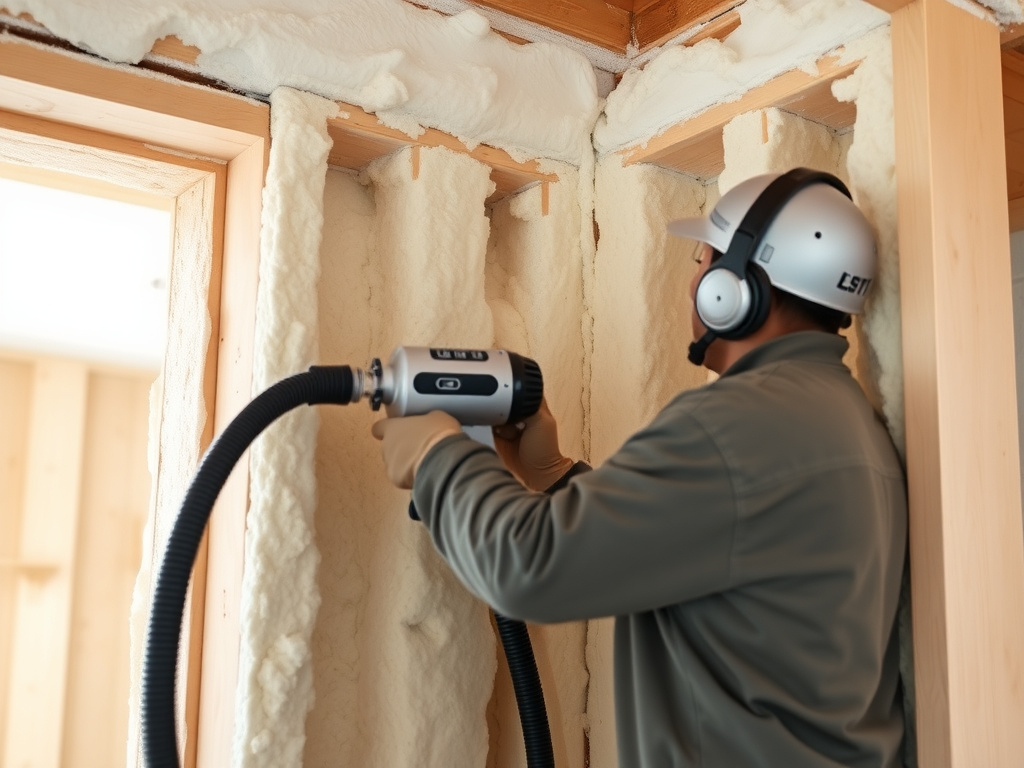
Closed-cell spray foam is a denser, rigid version of the same two-component polyurethane chemistry behind open-cell foam. Rather than an open, interconnected cell structure, its cells are sealed shut around a low-global-warming-potential HFO blowing agent, which is what gives it both its higher R-value per inch and its rigid, load-bearing texture. Cured density runs around 2 lb per cubic foot — the reason it's often just called "2-lb foam" on a bid or spec sheet.
That sealed structure delivers roughly R-6 to R-7 of thermal resistance per inch — nearly double open-cell foam's per-inch rating — which lets closed-cell hit a high target R-value inside a cavity that isn't deep enough for an equivalent open-cell fill. It's also rigid enough to add genuine racking strength to the wall, roof, or panel assembly it's sprayed into, which matters structurally on a metal building in a way an insulation product alone typically doesn't.
The property that matters most for this specific region, though, is vapor behavior. At sufficient thickness, closed-cell foam functions as a Class II vapor retarder — it resists moisture vapor movement through the assembly rather than letting it pass through, the opposite of open-cell foam's vapor-open structure. That distinction is the whole reason closed-cell exists as a separate product line rather than just "more expensive foam," and it's the reason this page exists as more than a mirror of our open-cell spray foam page.
Where open-cell is the right default for most residential attics and interior walls, closed-cell earns its higher per-board-foot cost on assemblies that need more R-value per inch, more structural rigidity, or genuine moisture resistance — and nowhere in this fleet's service area is that third factor more load-bearing than it is here.
| Density | About 2 lb per cubic foot — a rigid, dense cured texture, commonly called "2-lb foam." |
|---|---|
| R-value per inch | Roughly R-6 to R-7 per inch — close to double open-cell's per-inch performance, letting it hit a high R-value in a shallower cavity. |
| Structural contribution | Adds real racking strength to the assembly it's sprayed into — a genuine secondary benefit on metal buildings and wood-framed walls, not just an insulation product. |
| Vapor behavior | Functions as a Class II vapor retarder at sufficient thickness — it resists (rather than passes) moisture vapor movement through the assembly. |
| Blowing agent | Modern closed-cell formulations use HFO (low global-warming-potential) blowing agents rather than older, higher-impact chemistries. |
General closed-cell spray foam properties. Exact R-value, thickness, and vapor-retarder rating are confirmed for your specific assembly during a site visit.
The regional angle
Why closed-cell wins here specifically: cold storage near the Mariposa Port of Entry
The Mariposa Land Port of Entry in Nogales is Arizona's busiest commercial port — it processes roughly $36 billion in trade annually and functions as the primary U.S. port of entry for winter produce crossing from Mexico, with more than 5 billion pounds of fruits and vegetables moving through it every year. Santa Cruz County, and Rio Rico especially, hosts extensive cold-storage and dry-warehouse infrastructure built specifically to stage that produce, along with Foreign Trade Zone 60 and the newer construction that keeps following it.
A refrigerated warehouse has a problem an ordinary commercial building doesn't: a cooled interior surface sitting against warm, humid exterior air for most of the year, which is exactly the condition that drives condensation wherever moisture vapor can reach that cold surface. Ordinary metal-building insulation — batts, blankets, or open-cell foam — doesn't resist that vapor path. Closed-cell foam, applied at sufficient thickness across the roof deck and wall panels, does, because its sealed cell structure functions as a continuous vapor retarder rather than letting moisture pass through to condense against the cold metal behind it.
This isn't a generic Arizona commercial-building pitch — it's a specific, verifiable demand driver that exists in this service area because of the produce trade crossing at Mariposa, and it's the standout reason a produce distributor, customs-brokerage operator, or cold-chain facility manager in this region should be talking to a closed-cell contractor rather than a generic insulation crew.
Best applications
Where closed-cell foam performs best
Beyond cold storage, closed-cell foam is the right call anywhere an assembly needs more R-value per inch, added rigidity, or real moisture resistance:
- ✓Cold-storage and refrigerated produce warehouses near the Mariposa Land Port of Entry, where a vapor-resistant, high-R assembly is the difference between a dry building and a condensation problem
- ✓Metal building roof decks and wall panels — ranch shops, ag buildings, and pole barns across Patagonia, Sonoita, and rural Santa Cruz County
- ✓Below-grade and block/CMU walls, where moisture resistance against ground and masonry contact matters
- ✓Exterior wall assemblies exposed to direct sun and monsoon-driven wind-blown rain
- ✓Rim joists and other high-infiltration, tight-cavity details where a thin, high-R product outperforms a thicker open-cell fill
Ranch shops and metal ag buildings across Sonoita and Patagonia see a version of the same condensation problem at a smaller scale — a metal roof cooling fast on a freezing winter night, then facing humid morning air, is a setup for interior condensation dripping onto stored equipment. Closed-cell solves that the same way it solves it at warehouse scale.
Cost
What closed-cell spray foam typically costs
Closed-cell foam is priced by the board foot, same as open-cell, and typically runs in the range of about $1.00 to $1.65 per board foot in this region — noticeably higher than open-cell's roughly $0.45 to $0.90 band. These are directional, typical figures based on regional contractor pricing norms, not a fixed rate; every job, residential or commercial, gets an on-site quote before a number is final.
A worked example: a 600-square-foot exterior block wall sprayed to 2 inches of closed-cell foam — enough for a genuine vapor-retarder rating plus roughly R-12 to R-14 — works out to about 1,200 board feet. At $1.00 to $1.65 per board foot, that lands somewhere around $1,200 to $1,980 in material and labor before mobilization or a job minimum is added. A commercial cold-storage roof deck job scales up from there fast: a 4,000-square-foot warehouse roof sprayed to 4 inches (roughly R-24 to R-28 with a full vapor-retarder rating) works out to 16,000 board feet, landing somewhere in the $16,000 to $26,400 range before access, scheduling around produce-season activity, or job-specific logistics are factored in.
The higher per-board-foot rate is worth it wherever the assembly actually needs what closed-cell provides — the added R-value per inch, the structural rigidity, or the vapor resistance. Spraying closed-cell foam where open-cell would do the job just as well is an avoidable cost; spraying open-cell where closed-cell was actually required is a much more expensive mistake to fix later. We'll tell you plainly which case your building is before writing the quote.
Closed-cell vs. open-cell
Closed-cell vs. open-cell: the decision in practice
Most residential attics and interior walls in Nogales, Rio Rico, and Tubac are better served by open-cell foam — it costs less per board foot, fills irregular cavities completely, and performs better acoustically. Closed-cell moves ahead of it on metal buildings and ranch shops that need the structural rigidity, on any assembly where cavity depth is limited and a higher R-value per inch is required, and — decisively — on any building with a genuine moisture or condensation exposure: cold-storage and refrigerated warehouses, block and below-grade walls, and metal roofs facing direct monsoon-driven rain.
On some jobs the right answer is both, in a hybrid spec — closed-cell at the moisture-exposed roof deck or foundation wall, open-cell at interior partitions where sound dampening and cost matter more than vapor control. We spec that combination by assembly, not by a single blanket recommendation for the whole structure.
Install process
How the install works, from inspection to walkthrough
Inspection & spec
We assess the assembly — metal panel, block wall, refrigerated roof deck, or wood framing — and confirm thickness and vapor-retarder requirements before quoting.
Prep & masking
Surfaces are cleaned and primed where needed, and anything not being sprayed is masked and staged.
Spray day
Closed-cell foam sets fast, in lifts (passes) to control heat buildup and hit the specified thickness accurately across large roof decks or panel runs.
Cure & walkthrough
Cure time and re-occupancy or re-opening windows are confirmed on-site — commercial cold-storage jobs are typically scheduled around produce-season activity, not the other way around.
Commercial and cold-storage jobs get scheduling built around facility operations — after-hours spraying, coordination with an occupied building's safety requirements, and awareness that winter produce season is peak activity for most cold-chain buildings in this area. We plan around that calendar, not against it.
Code compliance
Code compliance basics for closed-cell installs
Closed-cell foam applied inside a living space or occupied commercial interior generally needs an approved thermal barrier, the same requirement that applies to open-cell foam, unless the specific product is tested and approved for exposed application. On metal buildings and unvented roof-deck assemblies, an ignition-barrier coating or covering is typically required over the foam unless the assembly is otherwise exempted by the applicable code path.
Santa Cruz County follows Arizona's adopted residential and commercial energy codes, built on Zone 3B's prescriptive requirements. On commercial and cold-storage projects specifically, we also confirm any facility-specific requirements — food- safety-adjacent surface finishes, fire-rating expectations for a warehouse occupancy class, or documentation a facility operator needs on file — before a crew is scheduled, not after.
Frequently Asked
Closed-cell spray foam — common questions
Why does cold-storage and warehouse insulation matter so much in this specific area?
+
Santa Cruz County hosts one of Arizona's largest concentrations of cold-storage and warehouse real estate, built to stage the produce that crosses through the Mariposa Land Port of Entry — Arizona's busiest commercial port, moving roughly $36 billion in trade and more than 5 billion pounds of fruits and vegetables annually. Refrigerated buildings have condensation and vapor-control problems that ordinary metal-building insulation doesn't solve, which is a genuinely regional demand driver for closed-cell foam that most Arizona markets simply don't have.
What's actually different about insulating a refrigerated warehouse versus a normal commercial building?
+
A refrigerated or cold-storage building has a cooled interior surface working against warm, humid exterior air for most of the year — exactly the condition that drives condensation at any point where vapor can reach a cold surface. A normal commercial building doesn't have that constant temperature differential. Closed-cell foam's vapor-retarder behavior at proper thickness controls that moisture path in a way a vapor-open product isn't built to do.
Can closed-cell spray foam help with condensation in a metal building or cold-storage facility?
+
Yes — that's one of its primary jobs on this kind of building. Applied at the right thickness across the roof deck and wall panels, closed-cell foam creates a continuous, vapor-resistant layer that keeps moisture from reaching the cold metal surface and condensing there, which is the failure mode that damages insulation, corrodes fasteners, and drips onto stored product in an uncontrolled building.
Do mice or rodents chew through closed-cell spray foam?
+
Closed-cell foam is more pest-resistant than fiberglass batts or loose-fill insulation, but it isn't rodent-proof, and ranch and rural outbuildings across Sonoita and Patagonia see real pest pressure. We pair foam installs with entry-point sealing at the perimeter, which does more to prevent an infestation than the foam material alone.
Get a closed-cell quote — residential or commercial
Tell us about your metal building, cold-storage facility, or high-moisture assembly and we'll come back with a straightforward, itemized quote — no obligation.
Related reading
Go deeper on foam types and commercial strategy
Open-Cell Spray Foam
The lower-cost, vapor-permeable default for most residential attics and interior walls across the service area.
Attic Insulation
The Zone 3B attic problem in full — sealed roof deck vs. conventional air-seal-and-blow-in, R-value targets, and the UES rebate walkthrough.
2026 Cost & Climate Guide
Board-foot pricing tables, project-cost scenarios, and the full border-region climate playbook for Santa Cruz County.