Know before you spend
Home Energy Audits — Nogales & Santa Cruz County
Before you pay for insulation, find out exactly where your home is losing conditioned air. A real audit — thermal imaging, blower-door test, duct leakage test, attic inspection — tells you what to fix first, and what you can safely skip.
What's included
What a professional energy audit actually checks
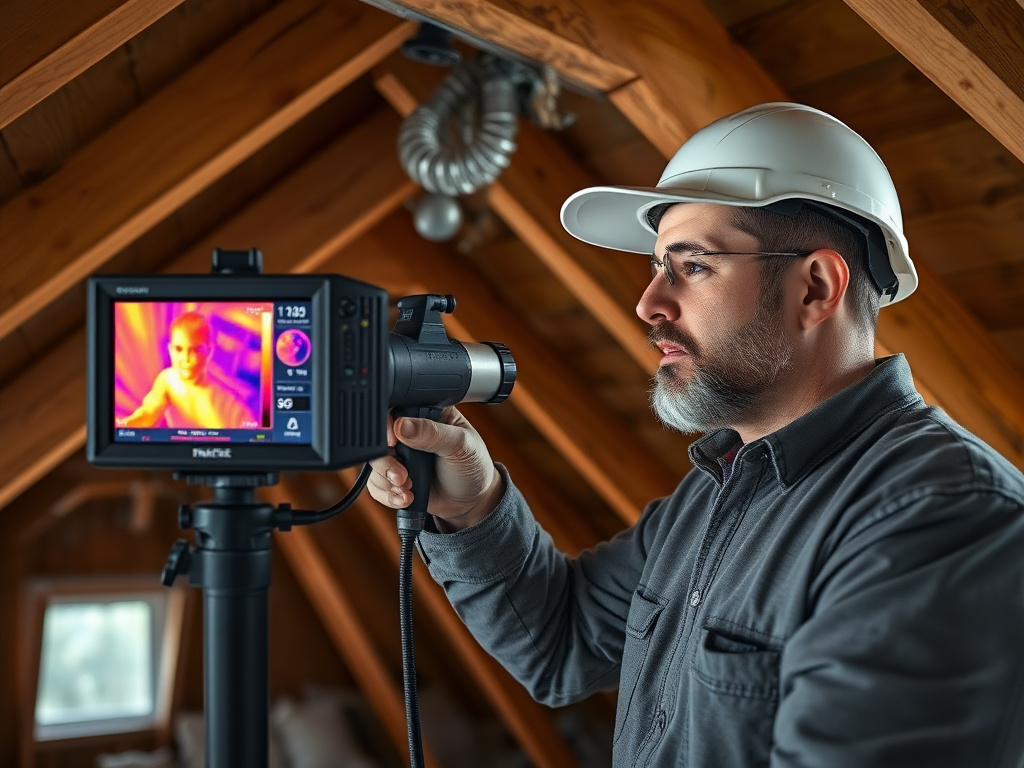
A lot of homeowners picture an "energy audit" as someone walking through with a clipboard and guessing. Ours isn't that. We run the same instrumented tests used to qualify homes for utility rebate programs — a thermal imaging pass, a calibrated blower-door depressurization test, a separate duct leakage test, and a physical attic inspection with insulation depth measured at multiple points, not just near the access hatch.
Each of those tests answers a different question. Thermal imaging shows you where heat is moving through the building envelope right now. The blower-door test puts a single, comparable number on how much outside air your whole house is exchanging. The duct test isolates whether your HVAC system is losing conditioned air before it ever reaches a supply register — a separate problem from envelope leakage that a lot of audits skip entirely.
We run all four together because they catch different failure modes. A house can have a tight envelope and still waste 20–30% of its conditioned air through leaky attic ductwork. Another house can have perfectly sealed ducts and still lose heat all winter through an under-insulated attic floor. An audit that only measures one of these gives you half the picture — and half the picture is how homeowners end up paying for insulation in the wrong place.
| Thermal imaging scan | An infrared camera pass across ceilings, walls, and window/door surrounds to find temperature anomalies — missing insulation, air leaks, and thermal bridging that aren't visible to the eye. |
|---|---|
| Blower-door test | A calibrated fan is fitted to an exterior door to depressurize the house and measure whole-building air leakage in a single number, then to help locate exactly where the air is moving. |
| Duct leakage test | Supply and return ductwork is pressure-tested separately from the building envelope, since a leaky duct system in an unconditioned attic wastes conditioned air before it ever reaches a room. |
| Attic inspection | A direct look at roof-deck condition, existing insulation type and depth, ventilation baffles, can-light penetrations, and any rodent or moisture activity — common findings on older border-region homes. |
| Insulation depth check | Measured depth at multiple points (not just near the attic hatch) compared against the R-38 floor / R-49 recommended target for this climate zone, so the report reflects the whole attic, not one sample point. |
What each test in a full audit measures, and why we run all four together.
What we actually find here
Regional findings — what Santa Cruz County audits turn up
The pattern of problems we find in Nogales, Rio Rico, Tubac, Patagonia, and Sonoita isn't the same pattern you'd see in a newer Phoenix-metro subdivision. Older border-town housing stock, working ranch outbuildings, and a real elevation gradient across the service area all show up in the audit data.
- ✓Older homes near downtown Nogales and the border corridor were often built with minimal original insulation, sometimes none in the attic floor at all.
- ✓Ranch and rural properties across Patagonia and Sonoita frequently have outbuildings — barns, equipment shops, guest structures — that were never insulated when built, and were never part of the original energy plan.
- ✓Seasonal-swing homes lose conditioned air in winter and gain heat in summer through the same leak points, so a single audit typically turns up findings relevant to both halves of the year, not just one.
- ✓Homes at higher elevation (Patagonia, Sonoita) show a different winter-loss profile in a blower-door test than a similar-sized home in Nogales proper — a real, measurable difference tied to elevation, not just a guess.
None of this means every home needs the same fix. It means the audit is doing real work — telling us whether your specific house behaves like a typical Nogales-proper retrofit or more like a higher-elevation Patagonia or Sonoita property with a heavier winter-loss profile.
The honest math
The dual-season savings math, explained plainly
A lot of insulation marketing in Arizona borrows Phoenix's cooling-only savings pitch and slaps a local city name on it. That doesn't hold up here. Santa Cruz County sits in IECC Climate Zone 3B — a genuine two-season climate, not Phoenix's cooling-dominated Zone 2B — and the audit report reflects that difference instead of glossing over it.
| Summer cooling swing | Real, but generally smaller than Phoenix's. Zone 3B summer highs here run roughly 90–100°F rather than Phoenix's 110–118°F, so the cooling-season savings from air-sealing and added insulation tend to land toward the lower-to-middle end of what a hotter, flatter desert climate would show. |
|---|---|
| Winter heating swing | A savings category Phoenix's cooling-dominated Zone 2B climate mostly doesn't have. Nogales-area winter lows regularly drop just below freezing, which means a leaky envelope is losing real heating dollars every winter night, not just discomfort. |
| Combined annual picture | Adding the two seasons together is the honest way to evaluate a Santa Cruz County audit. A smaller cooling-season number plus a real heating-season number can add up to combined annual savings comparable to a purely cooling-optimized market — it's just split across two seasons instead of concentrated in one. |
| Why this matters for the audit report | A report that only measures summer performance is only telling half the story here. Our audits document both a cooling-load estimate and a heating-load estimate so the payback math reflects the actual dual-season climate, not a copy-pasted desert template. |
Directional framing based on regional climate-zone data — your audit report gives you numbers specific to your home, not a generic estimate.
The practical upshot: if you've compared our numbers to a Phoenix-based estimate and wondered why the summer savings figure looks smaller, that's expected — and it's not the whole story. Your winter heating-season savings are a real line item that a Phoenix estimate simply doesn't have to account for. We show you both.
Rebate navigation
UES Efficient Home Program — what your audit qualifies you for
Every Santa Cruz County community we serve is UniSource Energy Services (UES) — UNS Electric territory. UES runs its own Efficient Home Program through Franklin Energy, and confirming your eligibility is part of the audit, not a separate step you have to chase down afterward.
| Program | UniSource Energy Services (UES) Efficient Home Program, administered by Franklin Energy. |
|---|---|
| Air-sealing only | 50% of installed cost, up to $250. |
| Air-sealing + insulation combined | 50% of installed cost, up to $800 — the tier most whole-attic projects fall under. |
| Eligibility | Home built 2005 or earlier; home plus guest house combined 3,500 sq ft or less; property not already enrolled as a UES Energy Smart Home. |
| Program contact | 866-540-4315 or UniSourceEfficientHome@FranklinEnergy.com — we can help confirm eligibility during the audit. |
| Federal tax credit status for 2026 | The federal Energy Efficient Home Improvement Credit (25C) ended after December 31, 2025 under the One Big Beautiful Bill Act. There is no federal credit available for 2026 insulation or air-sealing work — we tell every customer this plainly rather than advertise a credit that no longer applies. |
UES Efficient Home Program terms as of this writing — confirm current terms directly with the program before finalizing a project budget.
We say this plainly because a lot of sites still advertise a federal credit that no longer exists: the federal Energy Efficient Home Improvement Credit (Section 25C) ended after December 31, 2025 under the One Big Beautiful Bill Act. If you're planning a 2026 project, the UES program is the incentive on the table — there isn't a federal credit to stack on top of it anymore.
What you get
Your audit report and prioritized fix list
At the end of the visit you get a written report, not a verbal impression. It documents your blower-door number, duct leakage results, thermal-imaging findings by room, and measured attic insulation depth against the R-38 floor / R-49 recommended target for this climate zone. Where the elevation of your property changes the calculus — a Sonoita property at roughly 4,885 ft carries a different winter exposure than a Nogales property at roughly 3,865 ft — the report says so specifically.
We then rank the findings into a prioritized fix list: what's costing you the most conditioned air right now, what's a moderate-priority item, and what can reasonably wait. Not every finding needs to happen in the same visit or the same year — the point of the list is helping you sequence spending, not upselling every line item at once.
If you decide to move forward with install work, the audit becomes the starting point for your quote instead of a separate expense that gets thrown away. We don't re-measure your attic from scratch or re-run a blower-door test you already paid for — the numbers carry straight into the project scope.
That audit-to-install path also keeps your UES rebate paperwork consistent, since the eligibility confirmation and the installed-cost documentation the program wants both trace back to the same visit. For the most common next step after an audit, see our attic insulation page — it's where most prioritized fix lists start.
Schedule the visit
We confirm property type, approximate size, and whether outbuildings should be included in the scope.
Run the four tests
Thermal imaging, blower-door, duct leakage, and attic inspection with measured insulation depth.
Deliver the report
A written, prioritized fix list plus UES program eligibility confirmed against your home's build year and size.
Quote the fix (if you want one)
Audit findings roll directly into an install quote — no re-measuring, no duplicate charges.
Questions
Energy audit questions we hear most
How much does a home energy audit cost in Nogales or Santa Cruz County?
+
Pricing depends on home size, number of outbuildings, and travel distance for rural properties, so we treat any number as a directional estimate until we've scheduled the visit. Ask for a quote when you book and we'll confirm before the appointment — no surprise add-ons at the door.
Will the audit tell me if I qualify for the UES rebate?
+
Yes. Part of the audit is confirming your home's build year, combined square footage with any guest house, and whether the property is already enrolled as a UES Energy Smart Home — the three eligibility questions that determine whether you land in the $250 air-seal-only tier or the $800 combined tier.
Do you audit ranch outbuildings and shops, or just the main house?
+
Both, if you want them included. A lot of Patagonia and Sonoita properties have a shop, barn, or guest structure that's never been assessed for air leakage or insulation — those get walked and thermal-imaged as part of a full-property audit, not treated as an afterthought.
What happens after the audit — do I have to use you for the repair work?
+
No. You get a written, prioritized fix list either way. If you want to move forward with us, the audit findings roll directly into your install quote so you're not paying to have the same attic re-measured twice.
Find out where your home is actually losing energy
Book a full instrumented audit — thermal imaging, blower-door, duct leakage, attic inspection — and get a written, prioritized fix list plus a plain-language UES rebate check.
Related reading
Go deeper on attic performance and regional cost
Attic Insulation
The most common fix an audit turns up — sealed roof-deck foam vs. conventional air-seal plus blow-in, specced to your elevation band.
2026 Cost & Climate Guide
Cost tables, the Zone 3B climate playbook, and a full dual-season savings model for Santa Cruz County.
Service Areas
Elevation and local building-stock notes for Nogales, Rio Rico, Tubac, Patagonia, and Sonoita.