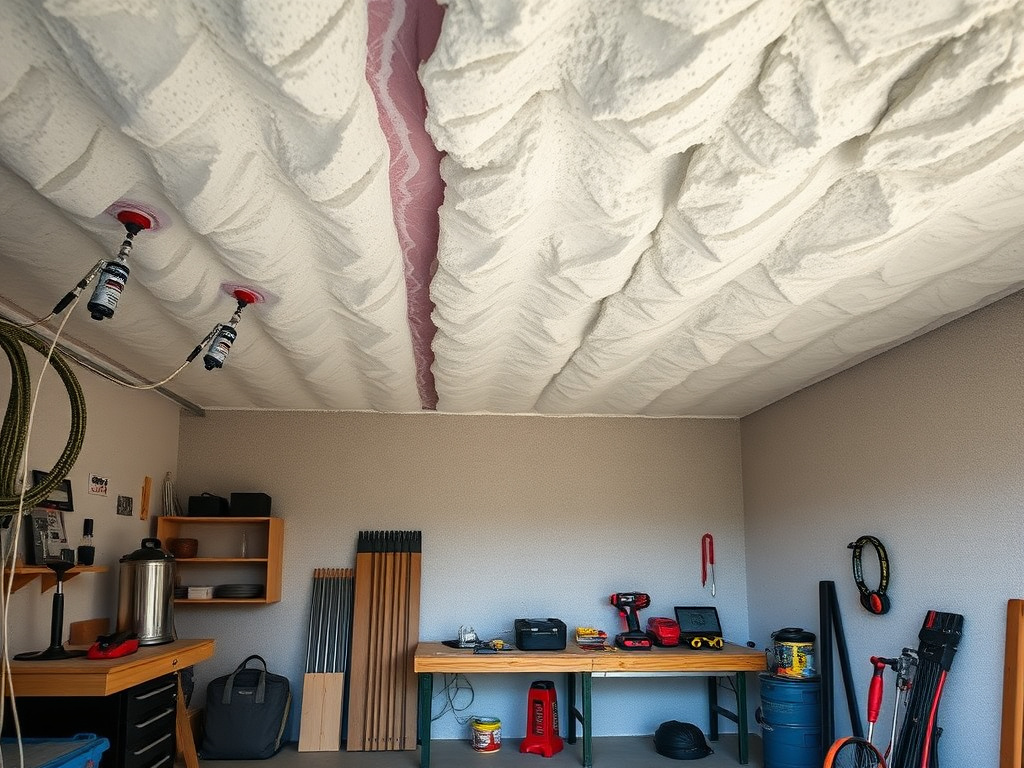
Garages, shops & outbuildings
Garage & Shop Insulation — Nogales, Rio Rico, Tubac & Santa Cruz County Ranch Properties
An uninsulated garage or shop fights you twice a year here — baking in summer, then losing heat fast on a freezing winter night. Spray foam addresses both, whether it's an attached two-car garage or a detached metal ranch shop.
The regional problem
Why garages and shops are a two-season problem here, not one
A lot of garage-insulation advice online is written for climates that only really fight one season — keep the heat out, done. That's not the whole story across Nogales, Rio Rico, Tubac, and the wider Santa Cruz County ranch belt. IECC Zone 3B means genuine summer heat, with garage and shop interiors regularly running hotter than the already-warm 90–100°F ambient outside. But it also means real winter cold — lows dropping just below freezing on a routine basis, especially at the higher elevations around Patagonia and Sonoita.
That matters for more than comfort. A ranch shop full of equipment, tools, and sometimes livestock feed or tack doesn't just get uncomfortable in a cold snap — batteries drain faster, fluids thicken, and anything sensitive to freezing is at real risk. A wine-country outbuilding near Sonoita or Elgin has its own version of this problem: temperature swings that make a space unsuitable for wine storage exactly when it would otherwise be most useful.
An attached garage adds a second wrinkle: it's usually connected to the house by a single interior wall that was never built to be a real thermal boundary. In summer, that wall lets garage heat migrate straight into the house's living space, working against the air conditioning. In winter, an unconditioned garage bordering a conditioned house does the reverse — pulling heat out of the house through the same shared wall.
Vehicle and tool storage adds up too. A garage or shop that swings from summer heat to near-freezing winter nights is genuinely harder on stored equipment, power tools, and vehicles than a space that stays in a moderate range year-round. Spray foam doesn't eliminate the swing entirely, but it meaningfully narrows it — which is the actual goal for most of the properties we work on.
Where to start
What to insulate, and the order that actually matters
Most garage and shop projects don't need every surface insulated on day one. We prioritize by where the heat gain and heat loss are actually happening, so a budget- limited project still targets the highest-impact area first.
- ✓Ceiling or roof deck first — the single largest surface exposed to summer heat gain and, at night, the fastest path for heat loss in winter.
- ✓Shared wall with the house next — the wall between an attached garage and living space is often the thinnest thermal barrier in the whole home.
- ✓Exterior walls third — especially on detached shops and metal buildings where the wall assembly is often just a single uninsulated metal skin.
- ✓Garage door last — weatherstripping and an insulated door panel help, but they matter far less once the ceiling and shared wall are sealed.
On an attached garage, the ceiling and the shared house wall together usually account for most of the thermal exchange we can measure. On a detached shop or metal building, the calculus shifts toward the roof and exterior wall skin, since there's no shared wall with a conditioned house to worry about — but there's often a bare metal surface to deal with instead.
Conversions
Spray foam for shop and garage conversions
Garages and outbuildings across this region get converted into real working space more often than most insulation guides assume. Spray foam is usually the right call for a conversion because it seals the assembly in one pass, rather than relying on separate air-sealing and batt-insulation steps that leave gaps at penetrations and framing.
- ✓Home workshops and tool storage where summer heat and winter cold both make the space unusable half the year without conditioning.
- ✓Wine-country outbuildings around Sonoita and Elgin, where stable temperature matters for wine storage and equipment, not just comfort.
- ✓Home offices and flex space converted from garage square footage, which need a real, code-compliant thermal envelope, not just a space heater.
- ✓Vehicle and equipment bays on working properties where temperature swings affect batteries, fluids, and stored tools as much as people.
For any conversion where the space becomes occupied living or working space rather than simple storage, the applicable thermal- and ignition-barrier code requirements change — see the code notes further down this page before finishing walls or drywall over foam.
Metal buildings
Detached shops & metal ranch buildings: why closed-cell wins here
Metal-frame shops and pole barns are the default construction type for a lot of ranch and rural properties across greater Santa Cruz County, especially around Patagonia and Sonoita. A bare metal skin creates a specific problem that a typical suburban garage doesn't have to deal with: condensation.
| The core problem | A bare metal roof or wall skin has almost no insulating value and reaches outside temperature fast in both directions — scorching to the touch in summer, ice-cold in a freezing winter night. |
|---|---|
| Condensation risk | When warm, humid air (common during monsoon season) contacts a cold metal surface, it condenses — dripping onto stored equipment, tack, feed, or vehicles inside a ranch shop or barn. |
| Why closed-cell is the fix | Closed-cell spray foam bonds directly to the metal skin and acts as a vapor retarder at typical application thickness, which stops the condensation cycle at the surface instead of just insulating around it. |
| Added benefit | Closed-cell foam also adds meaningful racking strength to a metal building's wall and roof assembly — a structural side benefit that open-cell foam and traditional batt or blanket insulation don't provide. |
| Where we see this most | Equestrian barns and equipment shops around Patagonia and Sonoita, and detached ranch shops across greater Santa Cruz County, where metal-building construction is the norm rather than the exception. |
Why closed-cell spray foam is our default recommendation for metal building interiors in this region.
For the full technical comparison between closed-cell and open-cell foam — density, R-value per inch, and when each one is the right call — see our closed-cell spray foam page.
Cost & code
Cost ranges and code notes
Garage and shop spray foam pricing follows the same board-foot logic as the rest of a spray foam project — square footage, foam type, and application thickness all move the number. A typical attached two-car garage ceiling-and-shared-wall project tends to land in a modest range compared to a whole-house attic job, simply because the surface area is smaller. A detached metal shop or barn scales differently depending on roof pitch, wall height, and whether the whole building envelope is in scope or just the roof deck.
Treat every figure on this page as directional. Rural properties across Patagonia and Sonoita sometimes carry a slightly wider cost range than in-town Nogales or Rio Rico jobs, purely because of travel distance and site access — we're upfront about that during the quote rather than after the crew shows up.
On the code side, spray foam in a garage or shop is a recognized, compliant insulation method — but the specific barrier requirement depends on how the space is used. Occupied space needs a real thermal barrier over the foam. Unoccupied storage or attic space can sometimes use an ignition-barrier coating instead. A garage conversion into an office, gym, or living space typically needs to meet the same standard as the rest of the house.
| Thermal barrier | Open-cell and closed-cell spray foam used inside living or occupied space generally requires a 15-minute thermal barrier — typically 1/2-inch drywall — over the foam, the same as standard residential code practice. |
|---|---|
| Ignition barrier | In unoccupied attic and crawlspace applications where a full thermal barrier isn't practical, code-compliant ignition-barrier coatings or approved foam products are used instead — this is a separate requirement from the thermal barrier and gets specified based on the space's actual use. |
| Detached shops & metal buildings | A detached shop or barn used for storage or equipment (not living space) is evaluated differently than a converted home office or living-adjacent garage — we confirm the applicable requirement for your specific structure before quoting, not after. |
| Garage conversions | Once a garage bay is converted into an office, gym, or living space, it's generally held to the same thermal- and ignition-barrier standards as the rest of the house — a detail worth confirming before finishing the walls. |
General code patterns for spray foam in garage, shop, and outbuilding applications — we confirm the specific requirement for your structure before quoting.
Walk the space
We look at ceiling, shared walls, exterior walls, and door condition to build the priority order for your specific garage or shop.
Confirm the code path
Occupied space, working shop, or unoccupied storage each carry a different thermal/ignition-barrier requirement — we confirm before quoting.
Quote by priority
You get a scoped quote that can start with the highest-impact surface and expand later, not an all-or-nothing number.
Spray & finish
Foam goes in, cures, and any required barrier finish (drywall or coating) is completed to code before handoff.
Questions
Garage & shop insulation questions we hear most
Does it make sense to insulate a garage in a climate like this?
+
Yes — and for two reasons most Phoenix-based advice misses. An uninsulated attached garage dumps summer heat straight into the house next door, and on a genuine Zone 3B winter night with lows near freezing, that same uninsulated space loses heat just as fast. Insulating it addresses both directions, not just the summer half.
What's a typical cost range to spray foam a garage or shop?
+
It depends heavily on square footage, ceiling height, and whether the shared wall with the house is included. Treat any number you see online as a directional starting point — we'll walk your specific space and come back with a real range before any work is scheduled.
Do you insulate detached shops, barns, and metal ranch buildings, or just attached garages?
+
Both. Detached shops and metal buildings are a big part of our work across Patagonia and Sonoita specifically, and closed-cell foam is usually the right call there because of the condensation and structural-strength benefits a metal skin needs.
Is spray foam in a garage or shop code-legal, and do I need a permit?
+
Spray foam is a recognized, code-compliant insulation method, but thermal-barrier and ignition-barrier requirements differ depending on whether the space is occupied living space, a working shop, or unoccupied storage. We confirm the applicable requirement for your structure and handle the permit conversation as part of the quote.
Get your garage or shop insulated for both seasons
Tell us whether it's an attached garage, a home workshop, or a detached ranch shop and we'll come back with a priority-ordered plan — no obligation.
Related reading
Go deeper on foam type and ranch-property insulation
Closed-Cell Spray Foam
Higher R-value per inch, added rigidity, and condensation control — the usual pick for metal buildings and shop conversions.
Ranch & Rural Property Insulation Guide
Shops, barns, equestrian structures, and wine-country outbuildings across Patagonia and Sonoita.
Service Areas
Elevation and local property notes for Nogales, Rio Rico, Tubac, Patagonia, and Sonoita.