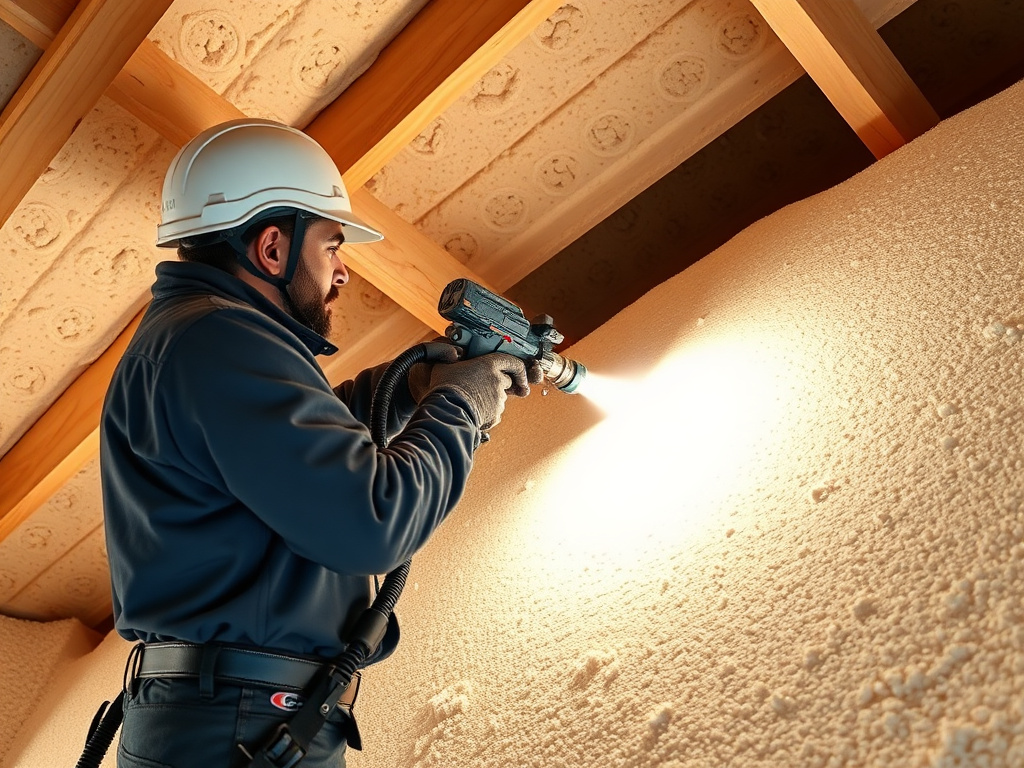
Open-Cell Spray Foam
Open-Cell Spray Foam Insulation in Nogales & Santa Cruz County
A half-pound, expanding foam that air-seals attics, interior walls, and sound-sensitive rooms in one pass — specified for a border-region climate that swings between 90–100°F summers and real freezing winter nights, not just one or the other.
What it is
What open-cell spray foam actually is
Open-cell spray foam is a two-component polyurethane that's mixed and sprayed as a liquid, then expands in place to roughly 100 times its liquid volume. The cured foam is soft and pliable rather than rigid — a texture difference you can feel by hand, and the reason it's often called "half-pound foam" after its approximate cured density of about 0.5 lb per cubic foot.
Because the cell structure is open rather than sealed, it delivers roughly R-3.5 to R-3.8 of thermal resistance per inch — lower per inch than closed-cell foam, which means it's typically specified at a greater thickness to hit the same target R-value. That trade-off is usually a good one: open-cell fills irregular rafter bays and wall cavities completely on expansion, air-sealing every gap and penetration a batt or blown-in product would leave behind.
The open cell structure also makes the foam vapor-permeable, sometimes described as vapor-open. Moisture vapor can move through it rather than getting trapped against one side of the assembly, which matters in an area that sees both a real summer monsoon humidity swing and, on the cooling side, air-conditioned interior surfaces. It also absorbs airborne sound meaningfully better than closed-cell foam of the same thickness — a genuine secondary benefit on interior partition walls, not just a footnote.
None of this makes open-cell the automatic right answer for every assembly on a property — see the comparison section below, and our full closed-cell spray foam page for where the higher-density product earns its place instead.
| Density | About 0.5 lb per cubic foot — a soft, pliable cured texture, sometimes described as "half-pound foam." |
|---|---|
| R-value per inch | Roughly R-3.5 to R-3.8 per inch, lower per inch than closed-cell, so it's typically specified at greater thickness to hit the same target R-value. |
| Expansion | Expands to roughly 100 times its liquid volume on contact, which is what lets it fill irregular framing bays and rooflines in a single pass. |
| Vapor behavior | Vapor-permeable (vapor-open) rather than a vapor barrier — moisture can move through it rather than getting trapped against one side of the assembly. |
| Sound performance | Its open-cell structure absorbs airborne sound meaningfully better than closed-cell foam of the same thickness, which matters on interior partition walls. |
General open-cell spray foam properties. Exact R-value and application thickness are confirmed for your specific assembly during a site visit.
Why it fits this climate
Why open-cell foam fits Santa Cruz County's dual-season climate
Santa Cruz County sits in IECC Climate Zone 3B — a semi-arid, "warm-dry" classification that's genuinely different from the low-desert Zone 2B climate covering Phoenix and Maricopa County. Nogales summers do get hot, with June highs averaging around 96°F and a real monsoon humidity swing arriving in July and August. But Zone 3B also carries a legitimate winter heating season: January and February daily highs average in the mid-to-upper 60s, and overnight lows regularly drop just below freezing across the service area.
That's the practical reason open-cell foam's air-sealing performance matters in both directions here, not just one. A sealed attic roof deck keeps 90–100°F summer heat from radiating into living space during the day, and it holds conditioned heat inside the envelope on a freezing January night — the same seal, working against two different problems at two different times of year. A Phoenix-style pitch that only talks about cooling-season savings misses half of what a Santa Cruz County property actually experiences.
The elevation gradient across the service area adds a real layer of nuance too. Tubac sits at roughly 3,230 ft, Nogales at roughly 3,865 ft, and Sonoita at roughly 4,885 ft — a genuine spread of about 1,650 ft across a compact region. A Sonoita property's winter exposure is measurably colder than a Tubac property's, even though both fall inside the same IECC zone, which is one reason we spec foam thickness by property and elevation band rather than off one generic countywide number.
Best applications
Where open-cell foam performs best
Open-cell foam's expansion and sound-dampening properties make it the right call for a specific set of assemblies more often than not:
- ✓Unvented attic roof decks — the highest-value application in this climate, sealing the single largest source of both summer heat gain and winter heat loss
- ✓Interior partition walls, for room-to-room sound dampening in border-region homes near highway and rail traffic
- ✓Shared garage-to-house walls, cutting vehicle and equipment noise along with thermal transfer
- ✓Bonus rooms and additions over unconditioned garages, where the floor assembly needs to be air-sealed as much as insulated
- ✓Interior walls in homes near the Nogales–Mariposa truck corridor, where commercial-crossing traffic noise is a real, ongoing nuisance
That sound-dampening property is worth calling out on its own in this region. Properties near the Nogales–Mariposa truck corridor and the border crossing itself deal with real, ongoing commercial-traffic noise — open-cell foam in shared and exterior-facing walls measurably cuts that noise transfer along with the thermal transfer, which is a genuinely regional reason to specify it beyond the standard attic application.
Cost
What open-cell spray foam typically costs
Spray foam is priced by the board foot — one square foot of surface area sprayed to one inch of thickness. Open-cell foam in this region typically runs in the range of about $0.45 to $0.90 per board foot, with the exact rate depending on thickness, access, and job size. These are directional, typical figures based on regional contractor pricing norms, not a fixed rate — every property gets an on-site quote before any number is final.
A worked example: a 1,200-square-foot attic sprayed to an average of 4 inches of open-cell foam — roughly R-14 to R-15, a common spec for supplementing existing insulation rather than a full unvented roof-deck retrofit — works out to about 4,800 board feet. At $0.45 to $0.90 per board foot, that lands somewhere around $2,160 to $4,320 in material and labor, before mobilization, masking, or a job minimum are factored in. That puts it inside the typical $2,000 to $5,000 range most attic jobs of this size land in across the service area.
A full unvented roof-deck conversion sprayed to a thicker, code-oriented spec — or a larger home, a harder-to-access attic, or a rural property further from Nogales proper — will move the total toward the higher end of that band or past it. Most contractors in this region, including us, also carry a minimum job charge, typically somewhere around $1,500 to $2,200, to cover mobilization and equipment setup on smaller jobs. Ask for a written, itemized quote before committing — a number that isn't broken out by board footage and thickness is hard to evaluate against a competing bid.
Open-cell vs. closed-cell
When we recommend closed-cell instead
Open-cell is the right default for most residential attic and interior-wall work in this region, but it isn't the right choice everywhere. We typically move a job to closed-cell foam when the assembly needs more R-value than the available cavity depth allows, when the structure needs the added racking strength closed-cell provides — common on metal buildings and ranch shops — or when the assembly faces a real moisture or condensation risk that calls for a vapor-resistant material rather than a vapor-open one.
That last case is genuinely significant in Santa Cruz County specifically: the cold-storage and refrigerated warehouse buildings staged around the Mariposa Land Port of Entry need an assembly that resists condensation forming against a cooled interior surface, which open-cell foam's vapor-open structure isn't built to do. That's a job for closed-cell foam, covered in full on our closed-cell page.
Install process
How the install works, from inspection to walkthrough
Inspection
We check the roof deck and attic for existing moisture, ventilation setup, and any active leaks before recommending open-cell, closed-cell, or a hybrid spec.
Prep & masking
Fixtures, ductwork, and anything not being sprayed get masked off, and access points are staged for the crew.
Spray day
Foam is mixed and applied to the specified thickness in a single visit for most residential jobs, with off-gassing ventilated as the crew works.
Cure & walkthrough
Most homes are safe to re-occupy within a few hours once the space is ventilated; we walk the finished job with you before we leave.
Re-occupancy timing depends on room size, ventilation, and total square footage sprayed — we'll give you a specific window for your property before spray day, not a generic rule that may not apply to a larger or harder-to-ventilate job.
Code compliance
Code compliance basics for open-cell installs
Unvented attic assemblies — where foam is sprayed directly to the underside of the roof deck instead of the attic floor — are a recognized construction method under current residential code, but they come with real requirements that aren't optional. Foam applied inside a living space or an unvented assembly generally needs an approved thermal barrier (commonly a code-rated ignition barrier coating or a covering like drywall) unless the specific foam product is tested and approved for exposed application, and unvented designs typically call for a documented approach to condensation control at the roof deck.
Santa Cruz County follows Arizona's adopted residential and energy codes, which build on the IECC Zone 3B prescriptive requirements for this region. We spec every unvented roof-deck job to meet the applicable thermal- and ignition-barrier requirements and pull permits where the jurisdiction requires one — this isn't a step we skip to save time, since a non-compliant install can create real problems at resale or during a future inspection.
Frequently Asked
Open-cell spray foam — common questions
Is open-cell spray foam a good fit for a border-region attic, or should I just go with closed-cell everywhere?
+
For most conditioned attic roof decks in Nogales, Rio Rico, Tubac, Patagonia, and Sonoita, open-cell is the more cost-effective choice — it's vapor-permeable, expands to fill irregular rafter bays completely, and costs less per board foot. Closed-cell earns its higher price where you need rigidity, a higher R-value in limited space, or vapor resistance against a condensation risk, which is a narrower set of applications on most residential jobs. See our closed-cell page for where that shift actually makes sense.
Does open-cell foam actually help in winter, not just summer?
+
Yes, and this is a genuine difference from a low-desert climate like Phoenix's. Santa Cruz County sits in IECC Climate Zone 3B, with winter lows regularly dropping just below freezing. An air-sealed, foam-insulated attic holds conditioned heat in on cold nights the same way it keeps 90–100°F summer heat out — it's the same sealed envelope working in both directions, which is worth accounting for when you're comparing a savings estimate that only talks about cooling.
How long until I can be back in the house after an open-cell spray foam install?
+
Most residential attic and wall jobs allow re-occupancy the same day, typically within a few hours once the foam has skinned over and off-gassing has dropped to a safe level, with the space fully ventilated first. Larger jobs or rooms with poor natural airflow may call for an overnight wait. We'll give you a specific re-occupancy window before spray day, not a generic rule of thumb.
Will spray foam hide a roof leak instead of fixing it?
+
It can, if a leak already exists and isn't found first — foam applied over an active leak location can mask water intrusion rather than solve it. That's why a roof-deck inspection for existing moisture staining or soft decking happens before we spray, not after. If we find an active leak, that gets addressed or flagged before foam goes in, not sprayed over.
Get an open-cell quote scoped to your property
Tell us about your attic, walls, or sound-dampening project and we'll come back with a straightforward, itemized quote — no obligation.
Related reading
Go deeper on foam types and attic strategy
Closed-Cell Spray Foam
Higher R-value per inch, added rigidity, and the vapor-resistant assemblies cold-storage buildings near the Mariposa Port of Entry need.
Attic Insulation
The Zone 3B attic problem in full — sealed roof deck vs. conventional air-seal-and-blow-in, R-value targets, and the UES rebate walkthrough.
2026 Cost & Climate Guide
Board-foot pricing tables, project-cost scenarios, and the full border-region climate playbook for Santa Cruz County.